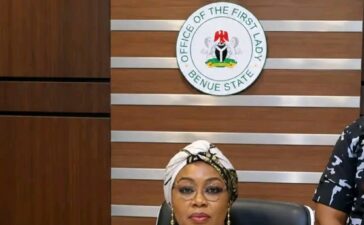
The Benue State Government has firmly defended Governor Hyacinth Alia’s decision to appoint Hon. Scholastica Terngu Ben-Sor as the coordinator of activities associated with the Office of the First Lady, rejecting calls for the wife of Deputy Governor Sam Ode to automatically assume the role.

In a statement, Chief Solomon Iorpev, the Technical Adviser to the Governor on Media, Publicity and Strategic Communication, clarified that the appointment was necessary because Governor Alia, a Catholic priest, does not have a First Lady. Iorpev emphasized that no law or regulation mandates that the deputy governor’s wife must perform the role in the absence of a governor’s spouse.
“Governor Alia, being a Catholic priest, does not have a First Lady. However, the absence of a First Lady does not extinguish the need for a coordinating office, particularly in relation to programmes initiated by the First Lady of Nigeria under the Renewed Hope Initiative,” Iorpev stated.
He explained that Ben-Sor, who serves as Special Adviser on Women Affairs, was directed by the governor to coordinate interventions targeted at women, children, and vulnerable groups in the state. Within the Renewed Hope Initiative framework, states must be represented either by a First Lady or a designated representative, making her role essential for Benue’s participation in federal programs.
Iorpev described the arrangement as a matter of gubernatorial prerogative, noting that the office of the deputy governor’s wife has its own distinct responsibilities. He cited precedents, including the administration of the late Rev. Fr. Moses Adasu, and pointed out that other states like Edo and Akwa Ibom operate similar setups with coordinators for the First Lady’s office even when deputy governors have spouses.
The clarification comes amid growing debate and criticism from some groups and individuals who believe the deputy governor’s wife should naturally step into the position. Iorpev dismissed these calls and alleged that some of the criticisms were politically motivated, claiming certain individuals were paid N50 million to discredit the governor, though he provided no evidence to support the allegation.
The issue continues to spark reactions across Benue State, highlighting differing views on tradition, governance, and the flexibility of roles not explicitly defined by law. The Benue government maintains that Governor Alia acted within his powers to ensure seamless coordination of women and youth-focused initiatives.