
In a development that has stirred hope among long-suffering civil servants in Benue State, the Local Government Service Commission has issued a special public service announcement addressing the plight of workers controversially declared as “ghost workers” between 2011 and 2012 during the administration of former Governor Samuel Ortom and then-Senator Titus Zam.
The affected employees, many of whom had served diligently in various local government areas, were abruptly removed from the payroll over a decade ago following a verification exercise that labeled them as non-existent or fraudulent. The decision left hundreds of families in financial ruin, with many workers denied salaries, pensions, and terminal benefits for years.
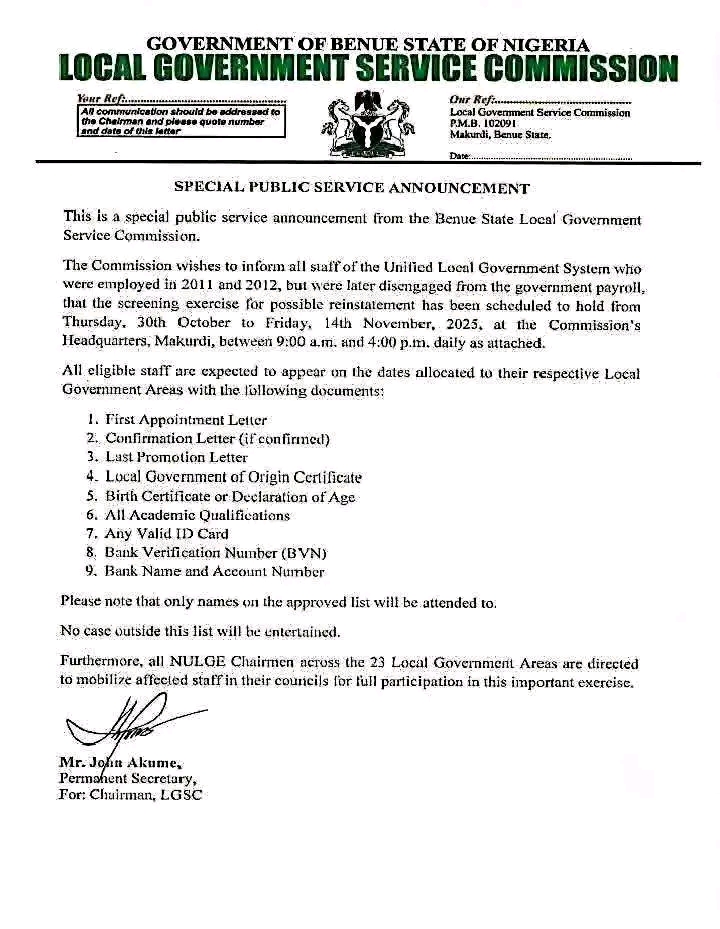
Now, under the administration of Governor Rev. Fr. Hyacinth Alia, the state government has initiated a verification and reinstatement process to right the wrongs of the past. According to the official notice from the Benue State Local Government Service Commission, all individuals affected by the 2011/2012 purge are required to appear in person for data capture and document validation.
The commission has outlined a strict list of required documents, including:
1. First Appointment Letter
2. Confirmation of Appointment Letter
3. Last Promotion Letter
4. Local Government of Origin Certificate
5. Birth Certificate or Declaration of Age
6. Certificate of State of Origin
7. Any valid ID card
8. Recent passport photograph (in white)
9. Bank Name and Account Number
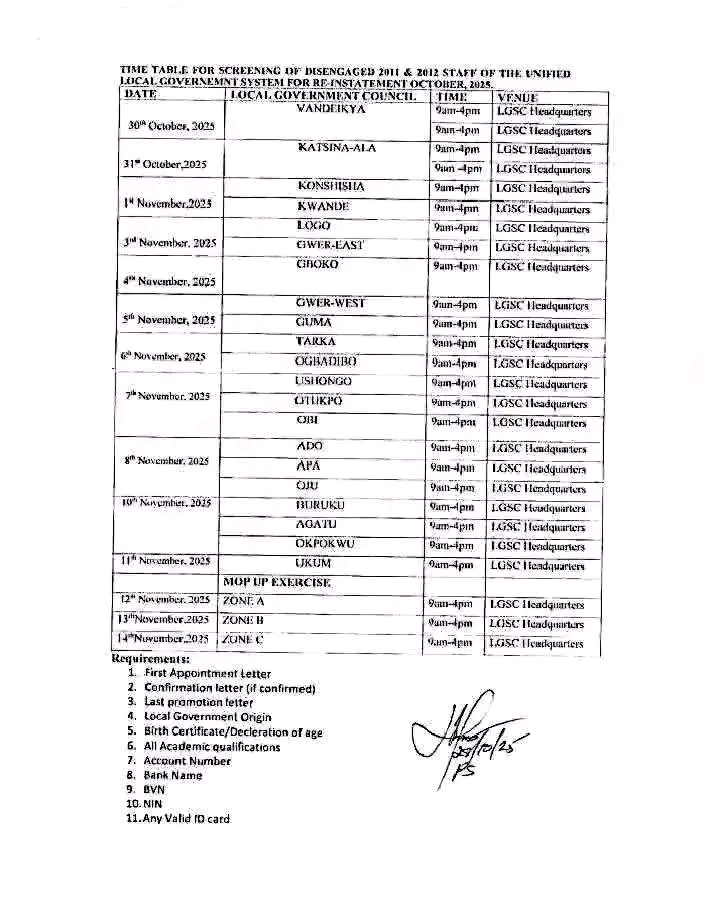
Additionally, applicants must present evidence of previous employment, such as pay slips or staff identity cards. The verification exercise is scheduled to run from Friday, 1st November 2024, to Friday, 14th November 2024, at the Commission’s headquarters in Makurdi.
The announcement emphasizes that only those who appear in person will be attended to, and no third-party representation will be accepted. Furthermore, all BVN-related issues must be resolved with the applicant’s bank before the exercise.
The notice, signed by the appropriate authorities, assures affected workers that the process is part of the Alia administration’s commitment to justice, transparency, and worker welfare. It comes as a significant policy shift, offering redemption to individuals who have spent over a decade in limbo.
Social media has been abuzz with reactions, with one affected worker-turned-activist, Tofi Simon Ternenge, posting on Facebook: “Governor Fr. Hyacinth Iormem Alia love you all, Congratulations in advance 2011/2012 employees declared ghost workers by Former Gov. Samuel Ortom and Senator Titus Zam.”
The post, accompanied by the official notice and a verification timetable, has garnered widespread attention, with many former workers expressing cautious optimism. For them, this is not just about reinstatement—it’s about restoring dignity, clearing their names, and securing long-denied entitlements.
While the Ortom administration had defended the 2011/2012 purge as a necessary step to sanitize the payroll and eliminate fraud, critics argued that the process was poorly executed, lacked due process, and unfairly targeted genuine workers. Many of those affected were never given a fair hearing or opportunity to defend their employment status.
As the verification window approaches, local government areas across Benue State are preparing to receive returning workers. The exercise is expected to have far-reaching implications—not just for the individuals involved, but for public trust in governance and payroll integrity.
For now, hundreds of families wait with bated breath. After more than a decade in the wilderness, the “ghosts” of Benue’s local government service may finally be laid to rest—with justice, not erasure.