Join our WhatsApp channel HERE for the latest Benue news and updates!
The political turbulence rocking the Benue State House of Assembly took a sharper turn on Friday, 5th December 2025, as the suspended member representing Gboko West constituency, Rt. Hon. Aondona Dajoh, filed a ₦2 billion lawsuit against the Speaker, the House of Assembly, the Inspector-General of Police, the Chief of Defence Staff, and the Department of State Services at the National Industrial Court in Abuja.

The suit, marked NICN/ABJ/368/2025 and received by the court on 5th December, challenges the six-month suspension slammed on Dajoh in November 2025, describing it as unconstitutional, unlawful, and a gross violation of Sections 36(1) and 101 of the 1999 Constitution as well as the Assembly’s own Standing Orders.

In the originating summons, Dajoh contends that he was denied fair hearing and had his legislative entitlements—including an alleged ₦8 million monthly overhead—abruptly withheld. He is praying the court to:
– Declare the suspension null, void, and unconstitutional
– Order his immediate reinstatement with full privileges
– Direct the payment of all withheld allowances from November to the date of judgment
– Grant two perpetual injunctions: one restraining the Speaker and Assembly from further suspending or excluding him, and another stopping security agencies from blocking his access to the Assembly complex
– Award ₦1 billion in general damages for psychological distress and another ₦1 billion in aggravated damages for what he terms the “unconscionable conduct” of the defendants
Dajoh, who had earlier served a three-month suspension, insists the latest action was politically motivated and lacked due process.
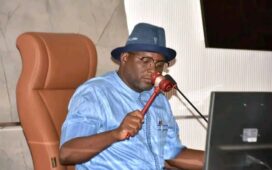
As at press time, neither the Speaker, Rt. Hon. Aondona Hyacinth Dajoh (no relation), nor the leadership of the Assembly has issued any official reaction to the lawsuit.
Political observers say the case has further polarised the House and could drag the lingering leadership crisis into a prolonged legal battle, with potential implications for legislative activities in the state.